A value set is a list of values that should be translated during data processing. This could be a common code set (e.g., LOINC, SNOMED) or a custom code set your organization uses.
A translation set is made of two value sets. You must create a value set for each code set you’re translating to and from between systems. Learn more about translation sets.
- All environment users can view value sets. However, a user must be assigned to an engineer or a support role to create or edit value sets. Learn about user roles.
- To delete a value set, you must first remove it from any active translation sets.
- Limitations:
- A value set can contain up to 7,500 values.
- A value set can’t be promoted independently. When a translation set is promoted, its value sets are promoted with it.
- Versioning: Editing a value set creates a new version but doesn’t automatically update an associated translation set. You must update the value mappings in the translation set to advance the version.
- Log in to the Redox dashboard.
- From the navigation menu, click the Operations drop-down.
- The Operations options expand. Click the Translations option.
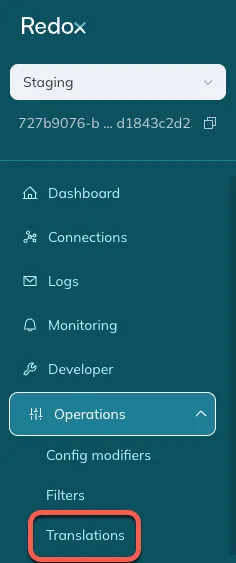


Translations in the side nav - By default, the Value sets tab opens. Review any existing value sets or create a new one.
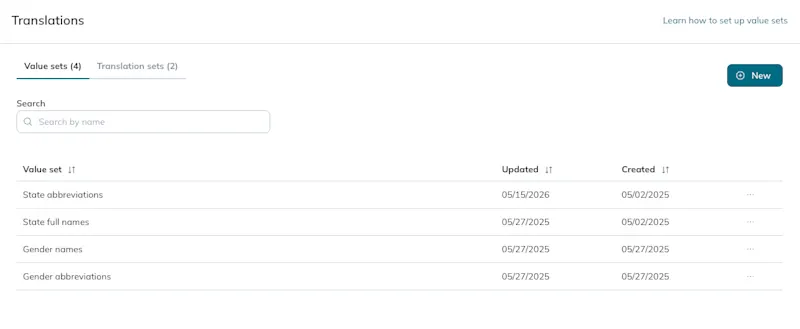
Value sets tab
- Follow the steps to view value sets.
- Click the New button.
- The create form opens. In the Name field, enter a human-friendly name for the value set. This name appears on the Value Sets tab and in the translation set create form when selecting value sets.
- Build your value set in the table. Type a value in a row. To add another value, press Enter on your keyboard or click the Add row button.Importing values (workaround)Value set limits
- Repeat for each value.
- If needed, click in the row to edit a value or the delete icon to delete it.
- Click the Create button.
Create a value set - The value set’s Details page opens. View recent activity, including who last updated the set, and what translation set(s) it’s applied to.
- If needed, repeat these steps to create another value set to map to. Remember, you must have two value sets to create one translation set.
- Follow the steps to view value sets.
- Find the value set you want to edit and click anywhere in its row.
- The Details page opens. Under the Value set details section, click the Edit button.
- The edit form opens so you can add, edit, or delete any values.
- Click the Save button.
Edit a value set - This creates a new version of the value set. To apply it, you must edit the associated translation set. Editing the translation set automatically pulls the new value set version forward.
- Navigate to the associated translation set. Click the Edit button.
- In the translation set, update the value mappings based on the edits you made to the value set. When you’re finished, click the Save button.
Can’t delete an active value set
- Follow the steps to view value sets.
- Find the value set you want to delete. Click the three-dots icon, then the Delete option. Alternatively, click anywhere in its row to open the Details page to review any details prior to deleting. Click the Delete button.
- A confirmation modal opens. Click the Delete button to continue.

Delete a value set
Platform API endpoints